5 Best AI Lead Generation Tools to Capture More Qualified Leads

Many websites convert only a low-single-digit percentage of visitors, meaning the overwhelming majority leave without becoming leads, which means valuable attention often disappears before a business can follow up.
The challenge is that lead generation software is no longer one-size-fits-all: some platforms convert existing content traffic, while others build funnels, find B2B contacts, automate outreach, or collect information through forms.
Choosing among the best AI lead generation tools therefore depends less on finding a universally “perfect” platform and more on matching the tool to your acquisition strategy.
This roundup compares five products across AI capability, setup time, pricing transparency, integrations, compliance, and reported results.
The tools were evaluated according to their stated audiences and primary use cases, including content-led capture, performance funnel building, B2B prospecting, AI sales engagement, and no-code forms.
Pricing and features can change, so verify current details with each vendor before purchasing.
What Is the Best AI Lead Generation Tool?
Here are our top picks for the best AI lead generation tool:
| Tool | Best For | Starting Price | Free Trial or Plan | Standout AI Feature |
|---|---|---|---|---|
| QuickSum AI | Turning blog and YouTube traffic into email leads | $99/month or $797 lifetime | 30-day trial | Content-specific summaries and AI video guides |
| LeadCapture | Compliance-ready funnels in regulated industries | $199/month | 7-day trial | AI Copilot funnel builder |
| Seamless AI | Fresh, verified B2B prospect lists | Free with 50 credits | Free plan | Real-time contact discovery |
| Amplemarket | Intent-driven multichannel outbound sales | $600/month annually | Free trial | Duo Copilot and intent signals |
| Jotform | No-code lead capture across industries | Free | Free plan | AI Agents for conversational capture |
Quick recommendation: Choose the tool based on where your leads originate.
Content traffic points toward QuickSum AI, paid or regulated funnels toward LeadCapture, outbound B2B prospecting toward Seamless AI or Amplemarket, and simple forms toward Jotform.
The 5 Best AI Lead Generation Tools Reviewed
1. QuickSum AI
Best for turning existing blog and YouTube traffic into email leads.
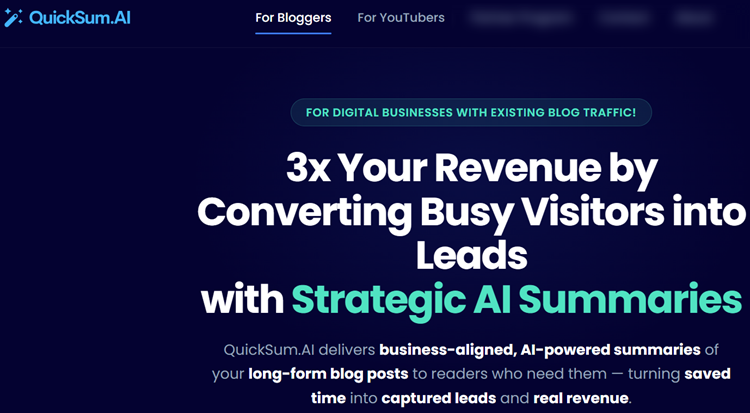
QuickSum AI is a content-led lead capture platform for bloggers, YouTubers, affiliate marketers, and digital businesses.
Instead of creating another downloadable ebook or interruptive pop-up, it offers readers an AI-generated summary of the article they are already reading in exchange for their email address.
For video creators, it can also generate AI video guides from YouTube content.
This makes QuickSum AI different from conventional prospecting tools because it monetizes attention you already own.
It is especially relevant to publishers exploring a solution for monetizing written content online without buying more traffic.
Key Features:
- Article-specific AI summaries aligned with the content and business goal.
- AI-generated video guides for YouTube channels.
- Behavioral triggers based on exit intent, scroll depth, time on page, and page-level targeting.
- Multi-variant testing with up to 10 versions per post.
- Smart caching that the vendor says can reduce AI API costs by up to 99%.
- Direct integrations with platforms such as Mailchimp, ActiveCampaign, HubSpot, Kit, Beehiiv, Klaviyo, Drip, and Kajabi.
- UTM tagging, affiliate-link preservation, analytics, and webhook support.
User Experience:
The platform is designed for non-technical creators and can be installed through Google Tag Manager in roughly 30 minutes.
Widgets can be customized to match a site’s branding, while leads flow into the user’s existing CRM or email service provider with article context and source tags.
The experience is strongest when the site publishes substantial, educational content and already receives consistent traffic.
Pricing:
The early-bird monthly plan is listed at $99 per month, discounted from $124.
The early-bird lifetime plan is $797 one time, discounted from $997, and includes a 30-day free trial.
Both plans include one website or domain, one YouTube channel, five AI-powered widgets, 25,000 embedded page views per month, unlimited blog posts per widget, and unlimited video guides per channel.
QuickSum AI uses a bring-your-own-key model, so users may also need a Claude or GPT API key and an email delivery service such as SendGrid or Resend.
That approach offers cost control, but it means the advertised subscription is not the only possible expense.
Pros:
- Excellent fit for existing blog and YouTube traffic.
- Offers a distinctive value exchange instead of a generic newsletter pop-up.
- Simple setup with broad email and CRM connectivity.
- Lifetime pricing may be attractive to long-term users.
- Supports analytics and content-level conversion testing.
Cons:
- Less useful for a new site without meaningful traffic.
Expert Opinion:
QuickSum AI is one of the most differentiated products in this roundup because it improves conversion from content that already exists.
A vendor-reported digital marketing blog case study describes revenue increasing from approximately $21,000 to $36,000 per month and subscribers rising from 247 to 3,487 per month over three months, although those figures should be treated as reported results rather than guaranteed outcomes.
For creators with at least 1,000 monthly visitors, it is a compelling option to test before investing in paid acquisition.
Get started with QuickSum AI.
2. LeadCapture
Best for compliance-ready lead funnels in regulated industries.
LeadCapture is an AI-assisted funnel platform built for performance marketers, lead-generation agencies, and businesses that need to capture, verify, qualify, and route leads.
Its strongest use cases include insurance, mortgage, solar, home services, and legal marketing, where a low-quality or non-compliant lead can be more damaging than a missed lead.
The platform combines pages, quizzes, surveys, forms, tracking, lead scoring, and integrations in one system.
For marketers comparing an AI funnel builder for regulated industries, LeadCapture is more specialized than a standard landing-page or form tool.
Key Features:
- AI Copilot that can generate a lead capture page, funnel, or quiz in approximately 60 seconds.
- Real-time email and phone verification.
- Contact scoring from 0 to 100 using validity, completion, and engagement signals.
- Lead enrichment, click-fraud detection, and session recordings on higher plans.
- TCPA and consent support through integrations such as TrustedForm and Jornaya.
- Conversion tracking for Meta, Google Ads, GA4, Google Tag Manager, and Everflow.
- Real-time routing through Zapier, webhooks, LeadProsper, LeadByte, Phonexa, GoHighLevel, and other systems.
User Experience:
The AI builder reduces the time needed to create a first funnel, while users retain control over copy, fields, page structure, and routing.
The interface is better suited to marketers managing campaigns than to someone who only wants a small newsletter form.
Founder-led onboarding and live support on selected plans may also help agencies operationalize the platform faster.
Pricing:
Monthly pricing starts at $199 for the Starter plan with 1,000 leads per month.
The Core plan costs $399 monthly and supports 10,000 leads, while Scale costs $699 monthly and supports 25,000 leads.
Annual billing lowers the effective monthly prices to $159, $319, and $559 respectively.
A seven-day free trial is available without a credit card, and the vendor advertises a 60-day money-back guarantee.
Enterprise pricing includes volume lead pricing, a data API, dedicated customer success, and custom development.
Pros:
- Strong combination of funnel creation, verification, and routing.
- Particularly useful for TCPA-sensitive and regulated campaigns.
- Unlimited AI Copilot usage on listed plans.
- Includes A/B testing and conversion tracking.
- No per-lead overage charges within plan capacity.
Cons:
- Starting price is high for solo creators and low-volume businesses.
Expert Opinion:
LeadCapture is a practical choice when lead quality, consent records, and routing matter as much as volume.
Its reported history of helping capture more than five million leads is a useful credibility signal, but buyers should still test verification accuracy and integration workflows with their own campaigns.
It is not the best option for content-led email capture, but it is among the strongest AI tools for lead capture in performance marketing.
Get started with LeadCapture AI.
3. Seamless AI
Best for building fresh, verified B2B prospect lists.
Seamless AI is a real-time B2B data and prospecting platform for SDRs, account executives, recruiters, marketers, RevOps teams, and founders.
Its key distinction is that it presents itself as a real-time search engine rather than a static contact database.
The platform researches contact information when users search, helping teams identify decision-makers and enrich incomplete or aging records.
This places Seamless AI firmly within the category of AI prospecting tools, rather than content marketing or inbound form software.
Key Features:
- Real-time search for business email addresses and phone numbers.
- A stated data engine containing more than 1.6 billion business emails and 448 million phone numbers.
- Buyer intent, job-change tracking, and data-enrichment products.
- Chrome extension for prospecting from sources such as LinkedIn.
- AI Agents for outbound, inbound, RevOps, marketing, recruiting, and other workflows.
- Integrations with Salesforce, HubSpot, Salesloft, Zoho, Pipedrive, Microsoft Dynamics, and thousands of other tools.
- Automatic credit-back protection for invalid emails, according to the vendor.
User Experience:
The free account can be created quickly, and the browser extension makes it easy to research prospects during normal selling workflows.
Users who need occasional list building may find the interface approachable, while high-volume teams will need a clear process for credits, enrichment, exports, and compliance.
Data quality should always be validated against the user’s market, geography, and target roles before a large campaign begins.
Pricing:
The Free plan includes one user and 50 credits.
Pro pricing is available through a sales conversation and includes annual credit packages, unlimited exports, integrations, and additional products that may be purchased as add-ons.
Enterprise plans offer custom packages, unlimited users, customer success, dedicated support, and quarterly business reviews.
Pros:
- Useful free plan for testing the product.
- Real-time research is a clear differentiation.
- Extensive integration and API ecosystem.
- Supports contact discovery, enrichment, job changes, and buyer intent.
- Credit-back protection can reduce the impact of invalid email data.
Cons:
- Paid pricing is not transparent without contacting sales.
- Credit usage requires careful monitoring at scale.
- It is not designed for bloggers or inbound content capture.
- Contact accuracy can vary by industry and region.
Expert Opinion:
Seamless AI is a strong candidate for teams whose biggest bottleneck is finding current B2B contacts.
The platform’s reported 1.6-billion-plus contact coverage is substantial, but list size alone does not guarantee deliverability or buyer relevance.
Start with the free credits, test several target segments, and confirm that the data integrates cleanly with your CRM before committing to a larger package.
Get started with Seamless AI.
4. Amplemarket
Best for intent-driven multichannel outbound sales.

Amplemarket is a sales engagement and outbound automation platform that combines contact data, AI research, intent signals, personalized messaging, sequences, deliverability tools, and reporting.
Unlike a pure data provider, it is designed to help sales teams move from identifying a prospect to engaging and following up with that prospect.
Its Duo Copilot is the central AI layer across research, writing, competitive intelligence, and buying signals.
For businesses developing intent-driven B2B outbound campaigns, Amplemarket offers a more complete workflow than a standalone prospect database.
Key Features:
- Duo Copywriter for personalized email creation.
- Duo Signals for identifying potential buying intent.
- Competitive intelligence monitoring.
- Multichannel sequences, workflows, analytics, and outbound dialing.
- Email validation, domain health monitoring, warmup, spam checking, and mailbox recommendations.
- Contact and company search, data enrichment, calendar enrichment, and job-change alerts.
- Duo Voice and Duo Inbox on higher-tier plans.
- Major CRM and go-to-market integrations.
User Experience:
Amplemarket is built for structured sales teams rather than casual users.
Onboarding can require more time because the platform touches domains, mailboxes, sequences, CRM processes, and deliverability.
Once configured, however, the unified workspace can reduce the number of disconnected tools sales representatives need to manage.
Pricing:
The Startup plan is listed at $600 per month on an annual term and includes two users, 27,000 contacts, multichannel sequences, AI intent signals, Duo Copilot, 13,500 annual email credits per user, and 600 phone credits per user.
Growth and Elite plans use custom pricing, with more users, contacts, credits, intent capabilities, and support.
All plans include a free trial, but prospective buyers should ask about user limits, mailbox requirements, credit allocations, onboarding, and deliverability support before signing an annual agreement.
Pros:
- Combines data, intent, messaging, and outreach automation.
- Strong deliverability and mailbox-management features.
- AI can reduce prospect research and copywriting time.
- Supports multichannel sequences and sales workflows.
- Suitable for startup, growth, and enterprise sales operations.
Cons:
- High starting price for individual sellers and small businesses.
- Annual commitment may be unsuitable for experimental campaigns.
Expert Opinion:
Amplemarket is best evaluated as an AI sales operating layer, not simply as a lead list provider.
The vendor reports outcomes such as a 60% increase in meetings booked, but results depend on targeting, offer quality, sales execution, and deliverability practices.
It is a serious option for teams that already have a defined ICP and enough deal value to justify an integrated outbound system.
Get started with Amplemarket.
5. Jotform
Best for no-code lead capture across multiple industries.
Jotform is a flexible form and workflow platform that supports contact forms, email opt-ins, quizzes, quote requests, payment forms, appointment bookings, surveys, and document collection.
Its AI Agents add conversational lead capture, allowing businesses to answer questions and collect information in a more interactive format.
Because it serves many industries, Jotform is particularly useful for small businesses, nonprofits, schools, healthcare organizations, service providers, and e-commerce teams.
It is a practical choice for organizations looking for interactive opt-in form builders without hiring a developer.
Key Features:
- Drag-and-drop form builder with more than 1,500 lead-generation templates.
- AI Agents for conversational chat, voice, SMS, and knowledge-base interactions.
- Conditional logic for personalized questions and lead qualification.
- Payment, appointment, file-upload, signature, and document capabilities.
- Integrations with CRM, email marketing, payment, and automation platforms.
- Jotform Tables for organizing and filtering submissions.
- GDPR and CCPA support, with HIPAA-enabled features on Gold and Enterprise plans.
User Experience:
Jotform is one of the easiest tools in this roundup to launch because users can begin with a template or build from scratch.
Its broad template library means a real estate business, nonprofit, educator, or consultant can usually find a suitable starting point.
The main usability challenge is deciding which fields and automations are genuinely necessary, since the platform provides far more functionality than a basic opt-in requires.
Pricing:
The Starter plan is free and includes five forms, 100 monthly submissions, 10,000 monthly views, and Jotform branding.
Paid annual plans begin at $34 per month for Bronze, $39 for Silver, and $99 for Gold, while monthly prices are $39, $49, and $129 respectively.
Enterprise pricing is custom and includes unlimited forms and submissions, multiuser access, SSO, dedicated support, custom branding, and HIPAA capabilities.
Pros:
- Free plan provides a low-risk starting point.
- Large library of templates and form types.
- Supports payments, appointments, signatures, and documents.
- AI Agents extend capture beyond static forms.
- Suitable for a wide variety of industries.
Cons:
- Free plan has strict form and submission limits.
- Jotform branding remains on the Starter plan.
Expert Opinion:
Jotform is the most accessible general-purpose option in this list.
It will not replace a B2B data engine or a performance funnel platform, but it can handle a surprising range of lead-generation workflows at a relatively low cost.
Businesses in regulated industries should review the specific plan and compliance requirements before collecting sensitive information.
Get started with Jotform.
How to Choose the Right AI Lead Generation Tool
The best choice begins with your lead source, not with the most impressive feature list.
If your audience arrives through search or YouTube, content-led capture may produce better results than cold outreach.
If you buy traffic or sell leads to clients, verification, consent, routing, and conversion tracking should take priority.
Budget and team size matter just as much.
Solopreneurs may prefer Jotform’s free plan or QuickSum AI’s lifetime option, while sales teams may justify Seamless AI or Amplemarket through pipeline value.
Agencies and regulated businesses should calculate the cost of bad leads, compliance failures, and manual routing before comparing subscription prices alone.
Finally, check integrations and operating requirements before signing up.
Confirm whether the platform connects to your CRM, email service, analytics tools, ad platforms, and consent systems.
For businesses collecting personal information, review recognized guidance such as ‘GDPR data protection principles' and confirm that your forms, consent language, storage, and follow-up process are appropriate for your jurisdiction.
Not sure where to start?
Match your traffic source and sales motion to the platform that fits it best.
QuickSum AI is strongest for creators with existing traffic, while LeadCapture is designed for high-volume and compliance-sensitive funnels.
Seamless AI and Amplemarket serve B2B sales teams, and Jotform offers the most accessible no-code starting point.
Comparison Matrix
The table below separates these platforms by function rather than treating every product as a direct substitute.
That distinction matters because a contact database cannot replace an opt-in widget, and a form builder cannot replace an outbound sequencing platform.
Each rating reflects practical fit for the audience identified in the product information supplied for this review.
| Feature | QuickSum AI | LeadCapture | Seamless AI | Amplemarket | Jotform |
|---|---|---|---|---|---|
| Primary category | Content-led capture | Performance funnels | B2B prospecting | AI sales engagement | Form-based capture |
| Core AI function | Summaries and video guides | Funnel creation and lead scoring | Contact research and verification | Intent, research, and outreach | Conversational AI Agents |
| Typical setup | About 30 minutes | Funnel in approximately 60 seconds | Minutes with extension | Guided onboarding | Minutes |
| Starting price | $99/month or $797 lifetime | $199/month | Free with 50 credits | $600/month annually | Free |
| Integrations | 20+ email and CRM tools | Zapier, CRMs, routing and compliance tools | 6,000+ tools | Major GTM systems | 100+ apps |
| Best audience | Bloggers and creators | Agencies and regulated businesses | SDRs and RevOps | Startup to enterprise sales teams | SMBs and organizations |
| Main limitation | Needs existing traffic and BYOK | Higher cost for small users | Paid pricing requires sales contact | Expensive for occasional prospecting | Usage limits on free plan |
Each product is assessed on four practical dimensions: AI depth, ease of setup, value for money, and integration power.
These scores are directional rather than laboratory measurements, because the right tool depends on traffic volume, team size, compliance needs, and sales process.
Frequently Asked Questions
What is AI lead generation?
AI lead generation uses artificial intelligence to identify prospects, create capture assets, personalize messaging, qualify contacts, or automate follow-up.
The technology may support inbound content capture, paid-traffic funnels, B2B list building, outbound sales, or conversational forms.
It does not remove the need for a clear offer, accurate targeting, consent, and thoughtful follow-up.
How much do these tools cost?
The tools in this roundup range from free plans to enterprise pricing.
Jotform and Seamless AI offer free entry points, QuickSum AI starts at $99 monthly or $797 for early-bird lifetime access, LeadCapture starts at $199 monthly, and Amplemarket starts at $600 monthly on an annual term.
Additional costs may include API usage, email delivery, credits, phone numbers, or implementation support.
Which tool is best for small businesses?
Jotform is usually the easiest low-cost starting point because its free plan supports basic forms and its paid tiers remain accessible.
QuickSum AI may be a better investment for a small content business with established traffic and long-form articles.
Seamless AI is worth testing for a small B2B sales team that needs prospect data but is not ready for a larger commitment.
Do these tools work with CRMs?
Most of them offer CRM or automation integrations, but the depth varies.
QuickSum AI connects with email platforms and CRMs through direct integrations and webhooks, LeadCapture supports routing and performance tools, Seamless AI connects with major sales systems, Amplemarket integrates with go-to-market platforms, and Jotform connects with many business applications.
Always test field mapping, tags, consent data, and duplicate handling before launching.

Final Verdict
There is no single winner for every lead-generation strategy because these five platforms solve different problems.
QuickSum AI is the standout for turning existing blog and YouTube traffic into email leads, especially for creators who want a distinctive content upgrade and may value its $797 lifetime offer.
LeadCapture is the strongest fit for compliance-ready, high-volume funnels in industries where lead verification and routing are essential.
Seamless AI is best for building fresh B2B prospect lists, while Amplemarket is better suited to teams that want intent signals, personalized outreach, and multichannel sales automation in one system.
Jotform remains the most flexible entry point for no-code forms, opt-ins, payments, appointments, and conversational capture.
Before buying, define your traffic source, monthly volume, CRM requirements, compliance obligations, and acceptable acquisition cost.
Then use a free plan or trial to test real workflows rather than judging features in isolation.
Bookmark this guide and share it with your team before your next tool evaluation, and find your best-fit AI lead generation tool by starting a free trial today.